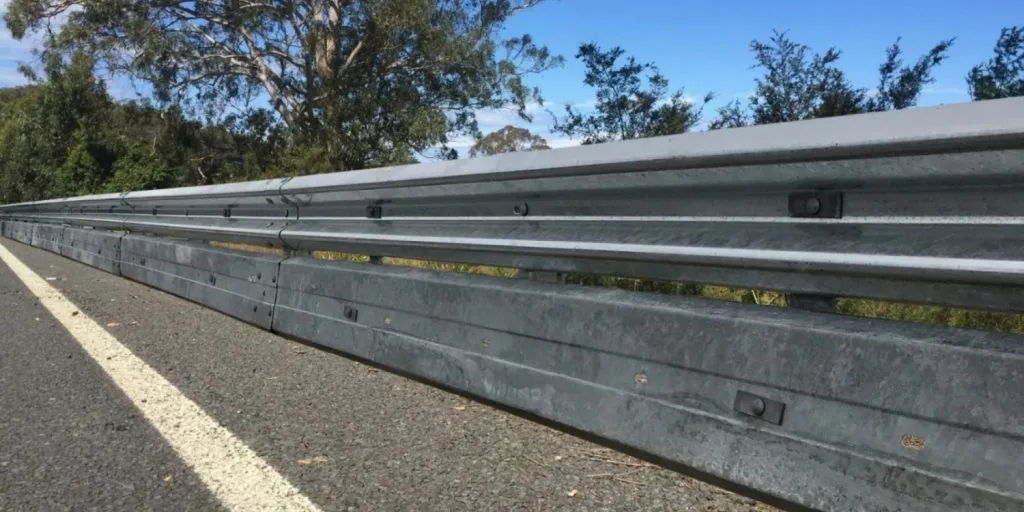
In San Francisco, guard rails earn their place on private property with grade changes and tight vehicle movements: parking lots cut into a hillside, the edge of a steep driveway, loading areas where trucks back toward a wall, and the open sides of parking decks. We install steel guard rail on private sites for owners and property managers. Rails on public streets belong to the city or the state and are not something a property owner arranges.
The right rail depends on what it has to stop. Highway-style steel beam on posts handles moving vehicles along a drive aisle or a drop. Pipe rail and bollards protect building corners, gas meters, electrical gear and pedestrian paths at lower speeds. On a hillside lot the posts on the downhill side need more depth, and where a rail sits on top of a retaining wall, the wall has to be able to take the load. That is a question for an engineer.
Corrosion is the long-term concern. Hot-dip galvanized rail and posts are standard, and they hold up well in fog and salt air without paint. Inside parking structures, posts are anchored to the slab instead of set in the ground, and the anchor layout has to respect the structure. We walk the site with you, mark where vehicles actually travel, and place the 811 ticket before any holes are dug.
Guard rails in San Francisco: common questions
Where do guard rails make sense on a San Francisco property?
Along the downhill edge of a driveway or parking area, in front of walls and equipment that vehicles back toward, at loading areas and around utility gear. Any place a car could roll or be pushed off a drop is the first priority.
Guard rail or bollards?
Guard rail stops vehicles along a line, such as the edge of a lot. Bollards protect a point, such as a doorway, a meter or a building corner, and let people walk through. Many sites use both.
Can a guard rail go on top of a retaining wall?
Only if the wall can carry the impact load. That needs an engineer's review, and the city may want a permit for it. Often the better answer is to set the rail on its own posts just behind the wall.
How it works
- Free estimate: Call, text or book online. We visit, measure and talk through options.
- Written quote: Clear pricing with material choices side by side.
- Permits & planning: We check local rules and help with permits before we dig.
- Install & clean-up: Our crew installs, cleans up and walks the finished fence with you.